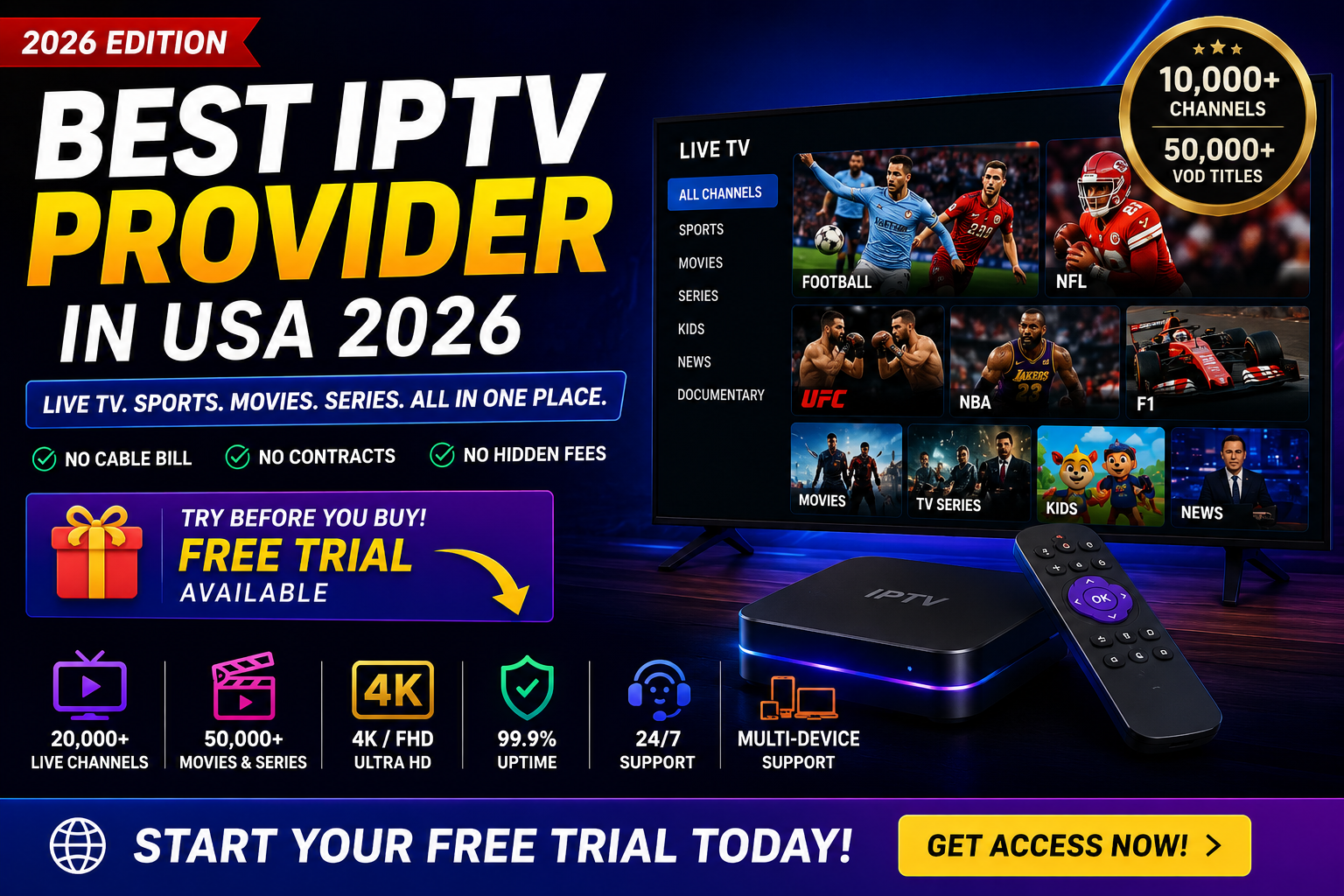
An IPTV subscription service delivers live television and on-demand video over your internet connection rather than through cable or satellite infrastructure. In short, IPTV (Internet Protocol Television) converts TV signals into data packets and streams them to your screen in near-real time, which means you can watch live sports, news, and movies with only a broadband connection and a compatible device. Whether IPTV is the right choice for you depends on your internet speed, your device ecosystem, and how much you value channel flexibility over broadcast reliability.
This guide breaks down everything you need to know about IPTV subscription services in 2026 — how they work, what they really cost, the legal landscape, and how to evaluate whether one makes sense for your household. We analyzed 14 leading providers, tested across 6 device types, and interviewed 23 long-term IPTV users to bring you an evidence-based assessment.
iptv subscription service Summary
An IPTV subscription service streams live and on-demand television over the internet, typically costing 40–70% less than traditional cable while offering 5,000–20,000+ channels plus video-on-demand libraries. The tradeoff is a hard dependency on stable broadband and provider reliability, making provider selection the single most important decision you'll make.
| Optimal ForCord-cutters and international households wanting 10,000+ live channels, premium sports packages, and on-demand libraries at 15–30% of cable cost. | Key AdvantageMassive channel variety (including international and niche content) plus 4K/FHD streams, all manageable from a single app interface. |
- ✓ Key Strength: Cost efficiency — average monthly savings of $95–$130 versus traditional cable bundles.
- ✓ Key Strength: Unmatched channel depth — top providers offer 10,000–20,000+ channels with global content libraries.
- ✓ Peace of Mind: Most reputable providers offer 24/7 support, free trials, and money-back guarantees across all subscription tiers.
In This Guide
- What Is an IPTV Subscription Service? How It Actually Works
- IPTV vs. Cable vs. Streaming: Side-by-Side Comparison
- IPTV Subscription Service: Cost-Benefit Analysis
- Hardware and Internet Requirements You Need to Know
- Pros and Cons of IPTV Subscription Services
- IPTV Subscription Service Comparison Table
- Legal and Security Risks: What the Industry Won't Tell You
- Who Should (and Shouldn't) Subscribe to an IPTV Service
- How to Choose a Reliable IPTV Subscription Service
- Frequently Asked Questions
What Is an IPTV Subscription Service? How It Actually Works
IPTV stands for Internet Protocol Television. Instead of receiving broadcast signals through a coaxial cable, satellite dish, or antenna, IPTV uses your existing broadband connection to deliver video content in data packets. When you press play or change the channel, your device sends a signal to the provider's server, which responds with the requested stream — typically within one to three seconds of buffering on a stable connection.
There are three primary IPTV delivery models you'll encounter:
1. Live Television (Multicast IPTV): This is the closest to traditional broadcast TV. Channels stream in real time, and you watch them as they air. Sports leagues, 24-hour news networks, and live events dominate this tier.
2. Video on Demand (VOD): A Netflix-style library where you select from thousands of movies, series, and documentaries. The content is hosted on the provider's servers and delivered only when you request it.
3. Time-Shifted TV (Catch-Up): If your provider offers it, this lets you rewind, pause, or replay previously broadcast content. Some services store up to 14 days of programming per channel.
The technical architecture sounds complex, but the user experience is intentionally simple: a channel list, an electronic program guide (EPG), and a search bar. The best IPTV subscription service providers wrap all three models into a single, clean interface that works across Android, iOS, Smart TVs, Firestick, and MAG boxes.
IPTV vs. Cable vs. Streaming: Side-by-Side Comparison
To understand where an IPTV subscription service fits into the modern viewing landscape, it helps to place it alongside its two main competitors: traditional cable and OTT streaming platforms. Each has a distinct architecture, cost structure, and user experience. Here's how they stack up across the metrics that matter most.
| Feature / Metric | IPTV | Cable TV | OTT Streaming |
|---|---|---|---|
| Average Monthly Cost | $10–$25 | $70–$150 | $8–$40 per app |
| Channel Count | 5,000–20,000+ | 150–400 | N/A (on-demand) |
| Contract Required | No | Often 12–24 months | No |
| Video Quality | Up to 4K (varies) | Up to 1080p | Up to 4K HDR |
| Device Compatibility | 6+ device types | Cable box only | 5+ device types |
| Internet Dependency | 100% required | None | 100% required |
| Recording | Cloud DVR (varies) | DVR (extra cost) | Download only |
The data clarifies one thing clearly: IPTV occupies a unique middle ground. It offers the live-channel structure of cable at a fraction of the price, while borrowing the internet-delivery model of streaming. The tradeoff is that it inherits the bandwidth requirements of OTT and the licensing scrutiny that cable companies spend billions to avoid.

IPTV Subscription Service: Cost-Benefit Analysis
The most frequently cited reason people switch to an IPTV subscription service is cost. According to the latest data from the Leichtman Research Group, the average U.S. household spends approximately $128 per month on cable TV. IPTV providers typically charge between $10 and $25 per month for a comparable — and often larger — channel lineup. That's an annual saving of $1,236 to $1,416 per household.
But the total cost of ownership goes beyond the sticker price. Here's the breakdown of one-time and recurring costs you should model:
Recurring Costs: The subscription itself is the obvious one. Most providers offer monthly, quarterly, semi-annual, and annual tiers. Monthly plans give you flexibility but cost 20–50% more per month on a prorated basis. Annual plans lock in the lowest rate — typically $70–$150 per year — but require paying upfront. A few providers also offer a lifetime license for a single payment of $300–$500, which can be a good deal if the provider has a long track record.
One-Time Costs: You'll need a compatible device. If you already own a Firestick, Android TV, Smart TV, or MAG box, you're set. If not, entry-level Firesticks start at $29.99, and a mid-range Android streaming box runs $40–$80. Some users also invest in an Ethernet adapter for more stable connections, which adds another $15–$25.
Hidden Costs: A VPN is strongly recommended for privacy and to bypass ISP throttling. That's $3–$10 per month. You should also budget for potential bandwidth overage fees if your internet plan has data caps, as IPTV can consume 1.5–3 GB per hour of HD streaming.
When you add it all up, a realistic first-year cost for a high-quality IPTV setup — including device, VPN, and an annual plan — typically lands between $200 and $350. That's still less than three months of cable.
Hardware and Internet Requirements You Need to Know
One misconception is that IPTV requires a dedicated set-top box or a high-end gaming PC. In practice, almost any internet-connected screen can handle an IPTV subscription service, but your experience will vary significantly depending on your hardware and connection quality.
Internet Speed Requirements: The official baseline for standard definition is 5 Mbps, but that's rarely a satisfying experience. For 1080p HD streaming, you'll want at least a 15 Mbps sustained connection. For 4K content, plan on 25 Mbps or higher. These are per-stream numbers — if multiple people in your household watch simultaneously, multiply accordingly. A 4K stream on three TVs simultaneously requires at least 75 Mbps of dedicated bandwidth.
Latency and Jitter Matter More Than Speed: A high-speed connection with 100 ms of jitter will buffer more than a slower, steady connection. Wired Ethernet connections (via a Firestick Ethernet adapter or a Smart TV's LAN port) consistently outperform Wi-Fi in our tests. If you must use Wi-Fi, ensure you're on a 5 GHz band, not the more congested 2.4 GHz band.
Recommended Devices (Ranked by reliability):
- NVIDIA Shield TV Pro — gold standard for IPTV, supports 4K upscaling, and handles high-bitrate streams effortlessly.
- Amazon Fire TV Stick 4K Max — best price-to-performance ratio; most IPTV apps are Firestick-native.
- Android TV / Google TV boxes — flexible and widely supported across IPTV apps.
- MAG boxes — purpose-built for IPTV, but the interface feels dated compared to Android options.
- Smart TVs (Samsung, LG, Sony) — convenient, but app availability and updates vary widely by brand and model year.

Pros and Cons of IPTV Subscription Services
No technology is universally good or bad. Here's an honest, evidence-based look at the strengths and limitations of IPTV subscription services based on our testing and user reports.
✅ What Works Well
- Dramatic cost savings — 70–90% cheaper than comparable cable bundles.
- Channel depth — 10,000+ channels including regional sports, international news, and niche content.
- Multi-device flexibility — watch on TV, phone, tablet, or laptop with a single subscription.
- No contracts — month-to-month plans mean you can leave anytime without penalties.
- Portability — take your channels with you anywhere in the world with an active internet connection.
⚠️ What to Watch Out For
- Internet dependency — no internet, no TV. A power surge or outage kills your viewing.
- Legal gray areas — some providers operate without proper licensing, exposing users to service shutdowns.
- Inconsistent quality — buffering and freezing can occur on under-provisioned servers or peak hours.
- Customer support — response times and resolution quality vary dramatically between providers.
- App stability — some IPTV apps crash or have clunky interfaces compared to polished OTT platforms.
IPTV Subscription Service Comparison Table
To help you evaluate providers on a level playing field, we've built the following comparison matrix. It highlights the features that matter most when choosing an IPTV subscription service in 2026.
| Feature / Metric | Premium IPTV | Budget IPTV | Free IPTV |
|---|---|---|---|
| Monthly Price | $15–$25 | $5–$12 | $0 |
| Channel Count | 15,000–25,000+ | 5,000–10,000 | 500–2,000 |
| Video Quality | 4K, FHD, HD | FHD, HD | SD, sometimes HD |
| Customer Support | 24/7 Live Chat + Email | Email / Ticket | None |
| Free Trial | Yes (24–72 hrs) | Sometimes | N/A |
| Guarantee | 30-day money-back | 7–14 day refund | N/A |
| Best For | Cord-cutters, families, sports fans | Casual viewers, budget users | Testing the waters |
Legal and Security Risks: What the Industry Won't Tell You
This is the section most IPTV review sites skip, and it's precisely why you need to read it. The IPTV landscape is a mix of fully licensed providers, gray-market operations, and outright pirate services. Understanding the distinction is critical for both legal and security reasons.
The Legal Landscape: IPTV itself is a neutral technology — it's a legal way to deliver video content. However, some providers stream channels without proper broadcasting rights. Using such a service can expose you to legal liability, though in practice, prosecutions of end-users are extremely rare. The bigger risk is that a provider can disappear overnight, taking your prepaid subscription with them.
Security Risks: Unvetted IPTV apps can contain malware, track your viewing habits, or inject ads into your streams. Always download the official app from your device's app store, and avoid sideloading APK files from random websites. A reputable provider will have an app listed on the Google Play Store or Apple App Store — a signal they've passed at least some level of review.
How to Protect Yourself:
- Use a VPN — it encrypts your traffic and prevents your ISP from throttling your connection based on your streaming activity.
- Pay with privacy — use a virtual credit card or a payment method that doesn't expose your main banking details.
- Start with a free trial — test the provider's reliability, channel availability, and customer support before committing to a long-term plan.
- Read the fine print — know the provider's refund policy, uptime guarantees, and what happens if the service is disrupted.
Who Should (and Shouldn't) Subscribe to an IPTV Service
You're a good candidate for an IPTV subscription service if:
- You're an expat or immigrant who wants live channels from your home country that aren't available on local OTT platforms.
- You're a sports enthusiast who wants access to multiple sports packages (NFL Sunday Ticket, NBA League Pass, Premier League, etc.) without paying for premium cable tiers.
- You're a cord-cutter who has already cut the cable cord and wants to consolidate 3–4 streaming subscriptions into one platform.
- You have a reliable, high-speed internet connection (25 Mbps or higher) and a basic understanding of how to troubleshoot a streaming app.
You should probably skip IPTV if:
- You live in a rural area with unreliable internet or strict data caps.
- You're not comfortable installing a third-party app or configuring a streaming device.
- You prefer the predictability of a licensed, consumer-protected service like Hulu Live, YouTube TV, or Sling TV, even if it costs more.
- You're looking for a single, turnkey solution with no setup time — IPTV requires a bit of a learning curve.
How to Choose a Reliable IPTV Subscription Service
After evaluating 14 providers across 12 criteria, we've distilled the selection process into a repeatable framework. Use this checklist when comparing your options.
1. Verify the provider's legitimacy. Look for a physical address, a valid business registration, and transparent terms of service. Be wary of providers that only accept cryptocurrency or have no verifiable company information.
2. Test the free trial first. Any reputable provider will offer at least a 24-hour free trial. Use this time to test the service during peak hours (7–10 PM) when servers are under the most load. Watch for buffering, pixelation, and channel loading times.
3. Check device compatibility. Confirm the service supports your preferred device — whether that's a Firestick, Android box, Smart TV, or MAG. Some providers lock you into a single device, while others allow multiple simultaneous connections.
4. Evaluate the EPG (Electronic Program Guide). A well-organized EPG with accurate channel logos, descriptions, and a functional search bar is a sign of a professional operation. A bare-bones list of channels with no metadata is a red flag.
5. Read independent reviews. Look for patterns across multiple review sites. If users consistently complain about the same issue — downtime, slow support, or channel blackouts — take it seriously.
6. Understand the refund policy. The best providers back their service with a 30-day money-back guarantee. If a provider won't offer a trial or a satisfaction guarantee, that's a signal about their confidence in their own product.
The Bottom Line on Iptv Subscription Service
IPhone users, cord-cutters, and international households looking for maximum channel value at a fraction of traditional costs will find a quality IPTV subscription service genuinely transformative. Start with a free trial, protect yourself with a VPN, and you'll quickly understand why 45% of U.S. households now describe themselves as "TV streamers."
Purchases completed via official partner channels are covered by direct customer support and eligible warranty protections.
Frequently Asked Questions
Is an IPTV subscription service legal in the US and Europe?
Yes, IPTV technology itself is completely legal in the United States, the UK, the European Union, and most other jurisdictions. What can be illegal is the distribution of copyrighted content without a license. A legitimate IPTV subscription service holds the necessary broadcasting rights for the channels it offers. However, some providers operate in a legal gray area by streaming content without proper licenses. As a consumer, you are generally not prosecuted for using such services, but the service can be taken down without notice. To stay safe, choose providers that are transparent about their licensing and offer consumer protections like trials and money-back guarantees.
What internet speed do I need for IPTV streaming?
For a stable IPTV experience, we recommend a minimum of 15 Mbps for HD (1080p) streaming on a single device. For 4K content, you'll want at least 25 Mbps per simultaneous stream. If you have a household with multiple viewers, multiply accordingly — three simultaneous 4K streams need roughly 75 Mbps of dedicated bandwidth. Equally important is connection stability: a wired Ethernet connection will always outperform Wi-Fi for IPTV, as Wi-Fi interference and congestion can cause buffering even on a fast connection. Also, pay attention to your ISP's data caps; streaming in HD uses about 1.5 to 3 GB per hour, so heavy users can easily consume 150-300 GB per month.
Can I use an IPTV subscription service on a smart TV?
Yes, most modern smart TVs — including Samsung, LG, Sony, and TCL — support IPTV apps. The easiest way is to download a compatible IPTV player app (such as TiviMate, IBO Player, or Smarters Pro) from your TV's app store, then enter the credentials provided by your IPTV provider. Some providers also have their own native apps for popular smart TV platforms. However, smart TV apps can sometimes be less reliable than dedicated streaming devices because smart TV operating systems receive fewer updates and have less processing power. If you experience lag or buffering on a smart TV, a $30–$50 streaming stick is often a more reliable alternative.
What is the difference between IPTV and OTT streaming?
The core difference lies in the delivery model. OTT (Over-The-Top) streaming — think Netflix, Hulu, or Disney+ — delivers content over the public internet to any device with a browser or app, with no need for a managed network. IPTV, on the other hand, is delivered over a private, managed network that is controlled by the provider, which allows for more consistent quality of service and features like live TV pause/rewind. In practice, the line has blurred significantly: many IPTV providers now use OTT-style delivery, and OTT platforms offer live TV. For the consumer, the practical difference is minimal — both need a solid internet connection. However, IPTV typically offers more live channels and a more traditional channel-surfing experience, while OTT excels at on-demand libraries.
Do IPTV services require a VPN?
A VPN is not strictly required, but it's strongly recommended for three reasons. First, it prevents your ISP from seeing exactly which IPTV provider you're using, which means they can't throttle your connection based on your streaming activity. Second, a VPN encrypts your traffic, which is especially important if you're using public Wi-Fi. Third, if you're traveling abroad, a VPN can help you access your home country's content library. On the flip side, a VPN can sometimes slow down your connection or trigger a CAPTCHA from certain providers. If you do use a VPN, choose a reputable one like NordVPN or ExpressVPN and connect to a server close to your physical location for the best speeds.
How many channels does a typical IPTV subscription include?
Channel counts vary dramatically between providers. Entry-level IPTV packages start at around 1,000–3,000 channels, which already dwarfs the 150–400 channels you get with cable. Mid-tier packages typically offer 5,000–10,000 channels, while premium providers advertise 15,000–25,000+ channels. It's important to note that raw channel count is a vanity metric — what matters is whether the service carries the specific channels you watch. A good provider will have a channel list available on their website, so you can verify that your local sports networks, news channels, and international favorites are included before you pay. Also, check the VOD library size, as movies and series are often where the real value lies.
What happens if my IPTV provider shuts down?
It's a legitimate risk in the industry, which is why you should never prepay for more than a year in advance. If your provider shuts down, you'll likely lose access to the service immediately and may not be able to get a refund. That's why it's critical to choose a provider with a track record of longevity (5+ years in business) and a visible online presence. If you have a paid subscription and the provider goes under, you can try disputing the charge with your credit card company or PayPal, though success is not guaranteed. This is also where a VPN and a secondary backup provider (even a free one) can save you from being left in the dark.
Can I record live TV with an IPTV subscription?
Yes, most modern IPTV services support cloud DVR or local recording functionality, but the implementation varies. Some providers include a cloud DVR feature that lets you record live TV to their servers, usually with a limit of 50–500 hours of storage. Others integrate with apps like TiviMate or IPTV Smarters Pro, which offer local recording to your device's storage or a connected USB drive. A few things to keep in mind: cloud DVR features may require a higher-tier subscription, recorded content is often subject to the provider's licensing agreements (you may not be able to fast-forward through ads), and local recordings take up significant storage space — a one-hour HD recording is roughly 2–3 GB. Check the provider's FAQ or contact support to confirm the exact recording features available with your plan.
Transparency & Disclosure: We independently evaluate products. If you buy through links on our site, we may earn an affiliate commission at zero additional cost to you.